All contributions

2021

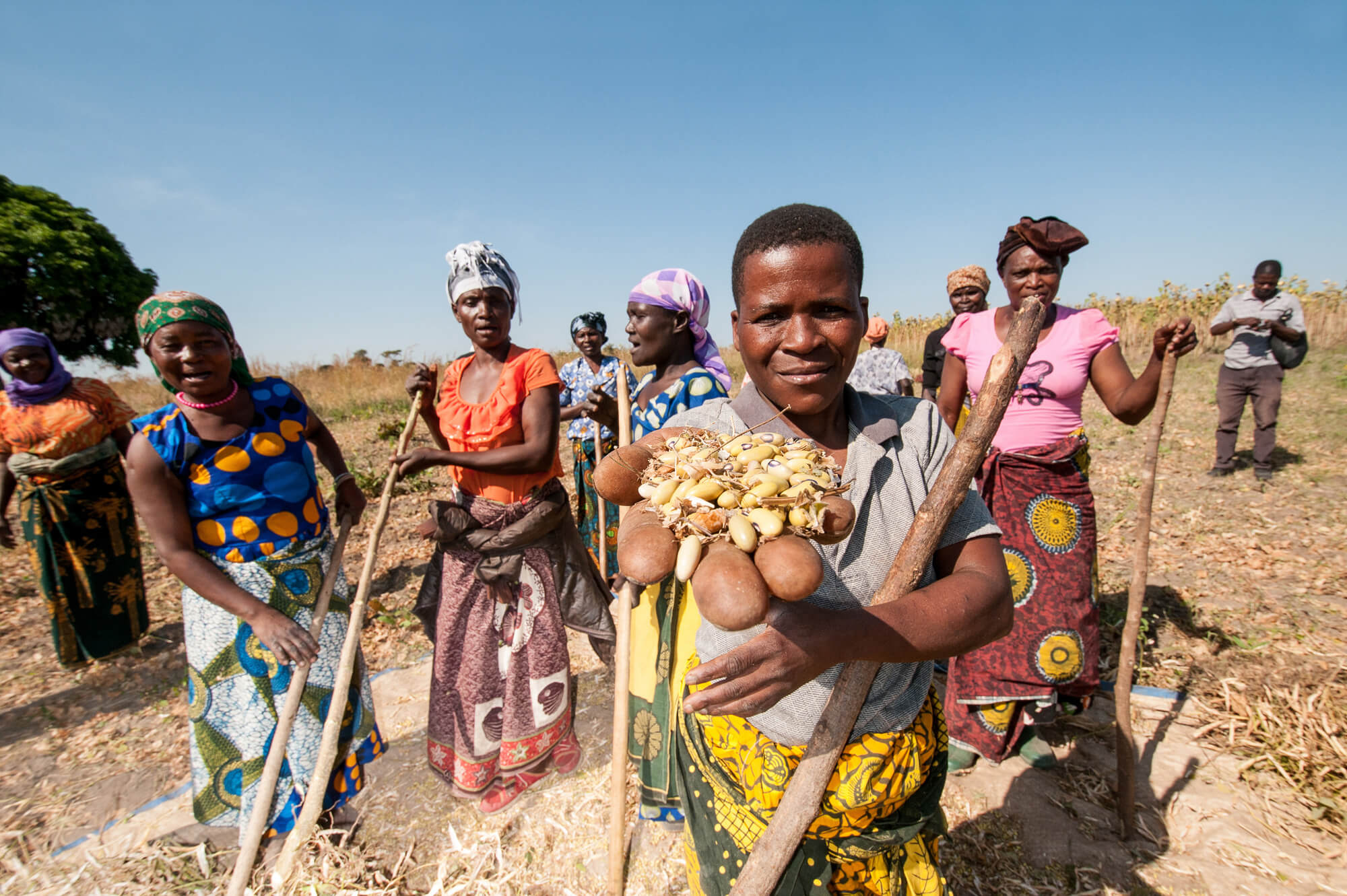
A group of women in colorful dresses proudly display harvested crops in a sunlit field, marking a successful start to their season.

A World without Hunger Is Possible

With the special initiative "One World Without Hunger" (SEWOH), the German government has set an example. Dirk Schattschneider, Commissioner for the Special Initiative at the Federal Ministry for Economic Cooperation and Development (BMZ) on achievements to date, lessons learned and the future of SEWOH.

With its special initiative for “ONE WORLD – no Hunger”, the German federal government issued a clear statement of intention. Soon commonly known as “SEWOH”, the initiative provided the opportunity to react flexibly within budgeting regulations and make an extensive contribution to fulfilling SDG 2. The political calendar provided various occasions to engage the international community through Germany’s G7 and G20 presidencies. The fact that the number of people suffering from hunger has increased since then does not undermine SEWOH’s efforts. Instead, it underpins the call to further intensify efforts on the national, European and global levels. The calendar still offers good vantage points. Great expectations rest on the United Nations Food Systems Summit, and in 2022 Germany will again take over the G7 presidency.

Read more

A man in traditional attire uses a tablet while sitting in a lush green field, with another person working in the background.

Accelerating Development in Rural Areas through Innovation

In order to make rural areas fit for the future and to sustainably improve the nutrition of many people, innovative approaches and solutions are needed. That is why SEWOH has created Green Innovation Centers, thereby providing important impetus for progress and innovation.

Read more

Two girls joyfully play soccer on a dusty field, capturing the spirit of playful perspectives.

Creating Prospects through Income, Employment and Participation

Perspectives must be created and existing potentials in the agricultural and food sector must be intensified so that people have the courage to pursue their future in rural areas. In its projects, the SEWOH promotes a comprehensive approach that focuses in particular on the needs of young people.

Read more

A group of five people studies a map and equipment in a dry, open field under a clear sky.

Securing Land Rights

Unresolved land ownership and rights of utilisation contribute to hunger and poverty and lead to conflicts over land, especially in Africa. The SEWOH therefore promotes various approaches to eliminate conflicts over land and to ensure responsible and sustainable agricultural land use.

Read more

Women joyfully sell vibrant tomatoes and peppers at a bustling outdoor market.

Securing a Balanced and Healthy Diet for Millions

810 million people suffer from hunger. Many more people are affected by "hidden" hunger. With the goal of "Zero Hunger" in mind, the SEWOH has implemented numerous measures and training programs to contribute to an improved nutrition situation.

Read more

Women in colorful attire plant young trees in a row, engaging in a community reforestation effort.

Preserving and Restoring Natural Resources

Through a series of projects, SEWOH is working to promote the rehabilitation of degraded soils, stop deforestation and restore forests and other wooded landscapes to create the basic conditions for intact and sustainable agriculture.

Read more

A woman in vibrant traditional attire holds a child, with a group gathered under a tree in a desert landscape.

Resilient Structures for a World without Hunger

Covid-19 drastically exacerbated the nutritional situation of millions of people and demonstrated that SEWOH's claim to strengthen resilient food systems and its flexible structures are the right approach to cushion and mitigate acute emergencies in crisis situations.


Read more

An elderly woman in traditional attire selects produce at a bustling outdoor market, surrounded by a group of onlookers.

Food System Transformation Starts and Ends with Diversity

A Contribution by Emile Frison and Nick Jacobs (IPES-Food)

While having failed to solve the hunger problem, industrial agriculture appears to be causing additional ones both in environmental and health terms. Emile Frison and Nick Jacobs call for a transformation.

Read more

A man smiles beside a motivational quote about ending hunger on a blue background.

What do you expect from this Pre Summit, Mr. Haddad?

Interview with Lawrence Haddad (GAIN)

Nutrition experts from all over the world are coming together in Rome. They are not only distilling 2000 ideas to improve food systems - they are also preparing for the big UN summit in New York in September. An interview. 

Read more

A man in a suit stands against an orange background next to a quote about producing food with nature.

Mr. Campari, how do we create sustainable food systems?

Interview with Joao Campari (WWF)

Journalist Jan Rübel spoke with Joao Campari ahead of the UNFSS Pre-Summit. The Chair of Action Track 3 highlights key challenges in transforming existing food systems towards sustainable production and shares his expectations for the Summit.

Read more

Livestock farming in Burkina Faso (c) GIZ/Jörg Böthling

Biodiversity and agriculture – rivalry or a new friendship?

A contribution by Irene Hoffmann (FAO)

In this article, the author describes what we know about interlinkages, what role agriculture has to play in the sustainable use and conservation of biodiversity, and what the necessary changes in agricultural systems might look like, both on small and large-scale farms.

Read more

Fishermen in hard hats unload a large net of fish onto a dock from a ship under a cloudy sky.

The fight against illegal fishing

A Report

The oceans are important for our food supply, but they are overfished. To halt this trend the global community is now taking action against illegal fishing. Journalist Jan Rübel spoke with Francesco Marí, a specialist for world food, agricultural trade and maritime policy at "Brot für die Welt," and others.

Read more

A group of joyful children run energetically down a sunlit dirt path surrounded by lush greenery in a rural setting.

Why successful transformation needs strong governance?

The special initiative One World no hunger (SEWOH) is one donor nation's attempt to decisively push forward the achievement of Sustainable Development Goal 2 (SDG 2). Observations and conclusions from the accompanying discourse.

In the summer of 2019, António Guterres, Secretary-General of the United Nations (UN), raised the alarm on the growing number of people going hungry. A “World Food Systems Summit” (UNFSS) in the autumn of 2021 intends to draw the necessary public attention to the issue of combatting hunger and increasing sustainability and provide fresh impetus for transforming the entire food system. In 2014, Germany’s Federal Minister of Economic Cooperation and Development, Gerd Müller, launched a remarkable experiment: SEWOH, the Special Initiative ONEWORLD No Hunger. The idea was to drastically advance UN Sustainable Development Goal 2 (SDG 2) with a sector approach initially driven by a single donor nation. Germany has invested around 1.5 billion euros annually towards achieving the UN goal, becoming the world’s second-largest donor in the fields of food security, rural development and agriculture. The initiative has explored new possibilities, yet it also had to face its limits. Vastly exacerbated by the Covid-19 pandemic, it had to realise the vulnerabilities of global food security.  

Read more

Three people walk along the dry, expansive landscape near Lake Chad under a dramatic, cloudy sky.

Climate crises

Population growth, lawlessness and dwindling resources, accelerated by climate change, are leading to conflicts that leave thousands dead across the Sahel every year. "Many will leave their homelands or perish from hunger, disease or wars. Only rapid socioeconomic development [...] would be able to prevent this disaster."

Read more

A world map highlights regions with projected hunger increases by 2030 and 2040, focusing on Africa, South Asia, and East Asia.

Climate change affects everyone, but not equally

Claudia Ringler, Deputy Division Director of EPTD at IFPRI, describes the adverse impacts of climate change and its related risks on populations in poor countries. What can be done to reduce the impact of climate change on food and nutrition security?

Read more

A woman at a bustling market stall hands a slice of watermelon to a customer, surrounded by various grains and vegetables.

Sustainable food systems: People drive change

To successfully combat hunger and malnutrition, we need a fundamental transformation of our conventional food systems. We asked experts and people on the ground who are actively involved in shaping sustainable, healthy and fair food systems.

Read more

A large assembly of delegates attentively participates in a conference under a distinctive oval ceiling light.

Creating a political momentum for global food governance

To feed the world's population in 2050, "the fine art of governance" is required, according to Jan Grossarth. With the help of the SEWOH partners, he has shed light on what this art includes and what challenges it encounters.

There has been some modest progress everywhere and in many thousands of local projects. But what if this won’t be enough in view of the global challenge? According to UN forecasts, Africa’s population is set to double by 2050, reaching over two billion people. Yet food imports on the continent are already exceeding exports, so it is not providing enough food for itself. Climate forecasts are predicting that in some African (and Asian) regions average temperatures will rise by 3 degrees or more. Moreover, deserts are spreading, with the prospect that development cooperation will be ineffective if it merely distributes resources under the watering can principle. 

Read more

The Svalbard Global Seed Vault stands against a snowy landscape under a clear blue sky.

The right to nutrition: how we can realise it

Stefan Schmitz is head of the Crop Trust and has been SEWOH Commissioner until 2019. We asked him which aspects of the SEWOH could be groundbreaking in order to achieve global goals such as SDG 2 at a national and a global level.

Read more

A woman in a mask holds a child adorned with necklaces, surrounded by women and children in a vibrant outdoor setting.

Global Hunger Index: Political action is the key

The World Hunger Index 2020 indicates that the goal of "Zero Hunger by 2030" will not be met. Miriam Wiemers, leading expert for the World Hunger Index, traces the main challenges and describes how the path to Zero Hunger can be taken.

Read more

A woman in a polka dot dress tends to a lush green cornfield under a bright sky, with a hoe resting on her shoulder.

In the land of conflicts 

Land is the foundation of life for most Ugandans. In central Uganda, an ancient land tenure system has caused an impasse for both landlords and tenants hence causing conflicts for decades. An innovative approach to conflict solving, and awareness-raising is about to create change.

Read more

Three outlined figures exchange ideas with speech bubbles on a bright yellow background, symbolizing a collaborative masterplan.

A masterplan for nutrition governance

Ending worldwide hunger by 2030 requires effective governance. This masterplan is based on the experience of the GIZ global programme for “Food and Nutrition Security, Enhanced Resilience,” which works on improving nutrition governance in ten countries around the world.

Read more