Dr Marlis Lindecke heads GIZ’s Advisory Service on Agricultural Research for Development (BEAF) Programme, based in Bonn. On behalf of the German Federal Ministry for Economic Cooperation and Development (BMZ), she and her team manage the support to the international agricultural research centres of the global research partnership for a food-secure future (CGIAR), the World Vegetable Center (formerly AVRDC) and the International Centre of Insect Physiology and Ecology (icipe).
Deutsche Gesellschaft für Internationale Zusammenarbeit (GIZ)
Shit Business is Serious Business smiles down in large letters on the side of the truck. The unusual slogan of a Nigerian mobile toilet company reveals what the truck has on board: faecal matter. Instead of tactfully paraphrasing his line of business, the resourceful entrepreneur Otunba Gaddafi has chosen a more direct marketing strategy, attracting much attention and recognition in the process. We seldom talk about the ‘other end’ of the food chain – too seldom to recognise that it may actually have positive aspects and not just waste removal issues. On the contrary; the shit business is not only a serious business. It also has the potential to be a crucial one. Human waste can play a major role in improving our food systems.
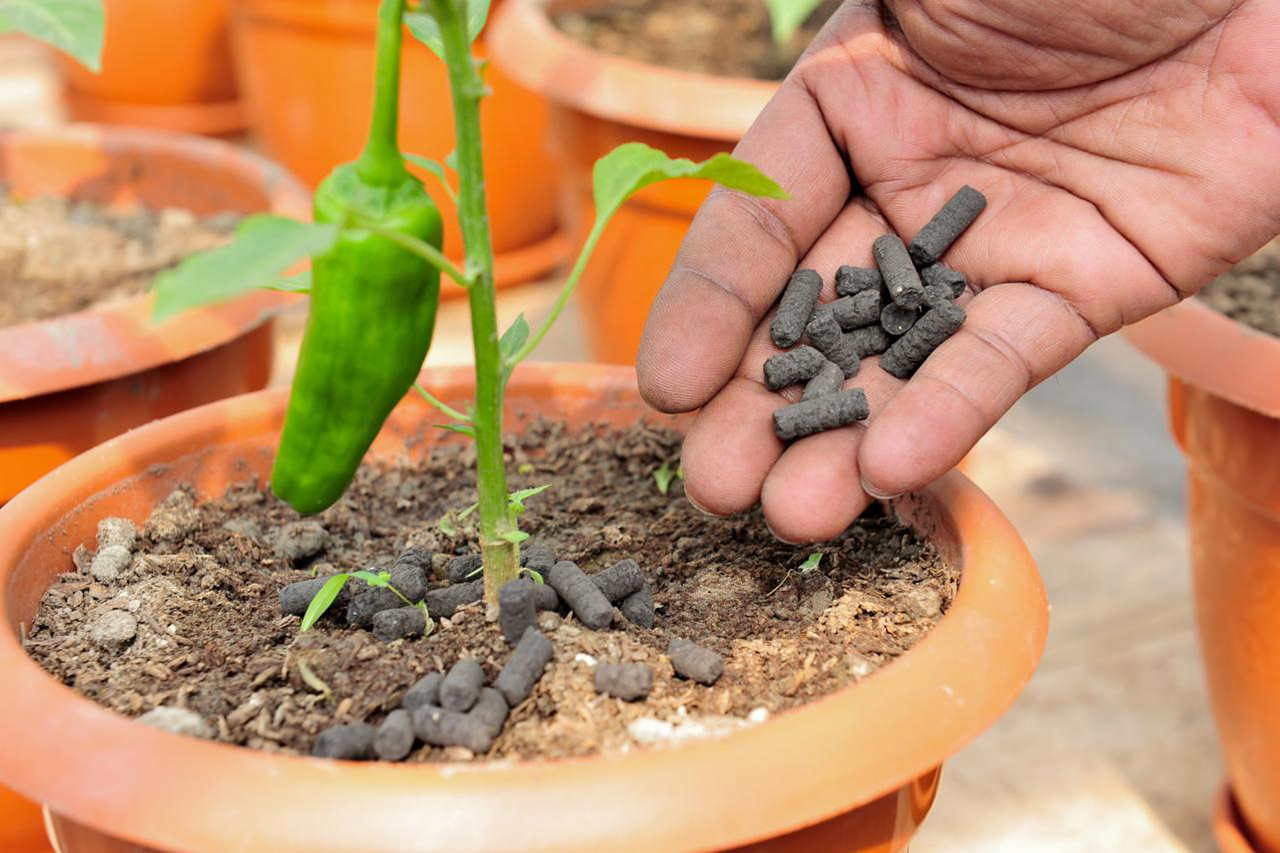
Safe, nutritous fertiliser pellets made from processed human waste at a trial site at Buet, Dhakar, Bangladesh. (c) Neil Palmer/IWMI
The International Water Management Institute (IWMI) and its partners are showing how this can be done with a public-private-partnership in Ghana. IWMI is one of the 15 research centres of the global research partnership for a food-secure future (CGIAR). In over 90 countries, CGIAR researchers develop widely applicable solutions such as new technologies, enhanced seed and adapted agricultural practices for smallholder farmers in developing countries. In the fight against hunger, malnutrition, poverty and degradation, not only research innovations are in demand, but also innovative research. Therefore, agricultural research does not focus on agricultural production alone, but also on its in- and outputs.
More food for providing a growing population
To produce more food for providing a growing world population with sufficient and healthy food, we require an increasing amount of water. Yet water is already in short supply in many places. Agricultural use already accounts for 70 per cent of all water extraction and the amount of irrigated land in developing countries is expected to grow – especially near urban centres. These intra-urban and peri-urban areas meet up to 90 per cent of the urban demand for leafy vegetables.
At the same time, many cities in developing countries do not have adequate sanitary systems and disposal facilities. In many Ghanaian cities, for instance, over 90 per cent of human waste from toilets is discharged directly into the environment with little or no treatment, contaminating land and water bodies. In and around Kumasi, with 2.5 million inhabitants the second largest city, farmers use such polluted water sources to irrigate approximately 12,000 hectares. The environmental problem therefore rapidly transitions into a health risk: The contaminated water flows along the food chain from the field to the plate, for instance in the form of irrigated green leafy vegetables. However, human faeces is a valuable resource for agriculture; as a source of biological fertiliser. In particular, countries that suffer from low soil fertility like Ghana need nutritious fertiliser urgently. Currently, most of the fertiliser applied is synthetic which is too expensive for most farmers and increases the risk of soil degradation.
The wastewater generated in the world’s cities alone could substitute a quarter of the nitrogen currently applied as synthetic fertiliser. In order to make sure that pollutants and pathogens do not contaminate food, faecal matter must be processed and applied appropriately. However, developing countries often lack the necessary financial capacities and physical infrastructure to implement such solutions.
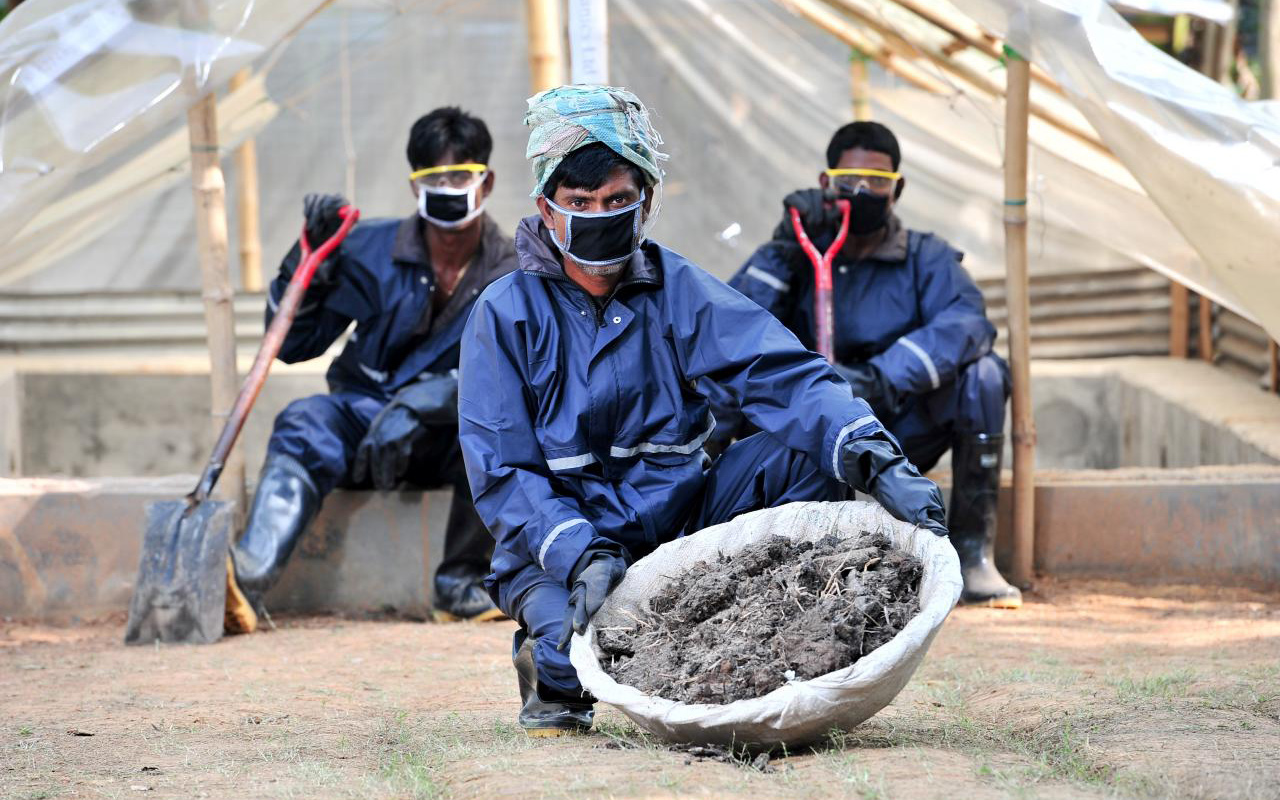
The process of mixing dried faecal matter to eventually produce fertiliser pellets, in Bangladesh. (c) Neil Palmer/IWMI
Together with its partners, the agricultural research centre IWMI works globally on broadly applicable solutions for sustainable use of water and land resources in developing countries. For this, IWMI involves increasingly the private sector. Even though the advantages of recycling and reuse of resources such as faecal matter are obvious, it is still a challenge to create economic opportunities from it when others see only (public) costs – and dirt. Together with its public and private partners, IWMI and other centres have developed various innovative technologies and products that transform human waste into high quality biological fertiliser – benefiting more people than just farmers.
One of these products is the Fortifer whose marketing and adoption is currently supported by the German Federal Ministry for Economic Cooperation and Development (BMZ). Fortifer, manufactured from faecal matter, food waste and minerals, can improve agricultural yields by 20 to 50 per cent compared with inorganic fertilizers, without reducing soil fertility. In its practical pellet form, Fortifer is also easy to transport and dispense. It also complies with the international safety standards of the World Health Organization, of course.
Taking temperature readings of windrows containing different combinations of fecal sludge. (c) Neil Palmer/IMWI
Close to Accra, Ghana’s first public-private enterprise dedicated solely to producing an affordable fertilizer of this type has recently been launched. Ghana’s Government contributes land while the private sector has committed financial resources to cover the operating maintenance and marketing costs until breakeven. By producing high quality fertiliser in Ghana, the country’s dependency on imports decreases while new opportunities for the local economy arise. The disposal of faecal matter and food waste is used to generate a resource that can fund livelihoods. Jobs are created along the entire value chain: from transport and processing to trading and engineering. The success of the project has already impacted policy: Ghanaian ministries officially approved commercial production of the pellets and included waste-based composts in its national fertiliser subsidy program.
IWMI initiated the project and facilitated its scientific process from market analysis to product development. Researchers are still involved in order to develop the research results into a long-term business model. The cooperation between agricultural researchers, the Ghanaian Government and private investors created a model solution with high potential that could be replicated in other countries – such as Sri Lanka, where IWMI is currently testing the same Fortifer with BMZ support. With the aim of fostering further initiatives, IWMI has analysed Fortifer as well as other products and business models for faecal sludge management, and developed practical guidelines.
Public-funded research for development – with private-sector involvement
The IWMI project is just one example of how agricultural researchers and the private sector can join forces to develop innovative solutions and put them into practice. Many partners are required in order to create these custom, needs-oriented products, as they cannot be developed effectively without the input of their eventual end users. To have a long-term impact, they also have to be profitable. Especially where public services are weak or non-existent, larger private-sector partners play a key role in bringing the results of research into smallholder practice. All of the 17 agricultural research centres supported by Germany therefore do not merely contribute to developing solutions with their expertise and results. They also have the crucial task of acting as knowledge brokers and actively engaging in, initiating and managing partnerships.
For we need not merely more but also more diverse foods in our diets to combat hidden hunger and malnutrition.
Yet international agricultural research does not only cooperate with the private sector. It is also an important counterweight to the major players on the market, the international agricultural conglomerates. It produces public goods that are freely available around the globe and are not limited in their usage by patents. Furthermore, researchers work on crops like millet and cassava that may be less interesting commercially, but play crucial roles in terms of world food security as staple dishes in developing countries. For we need not merely more but also more diverse foods in our diets to combat hidden hunger and malnutrition. International agricultural research has a public mandate: mitigate hunger, poverty and degradation. Its results cannot be geared toward profit – but they can very well be profitable. Examples like the Fortifer prove that this is indeed possible. And those who find the idea of ‘shit business’ too blunt may find alternatives: IWMI has analysed another promising business model in India. Here, the transporters that pump out faecal sludge in exchange for a small fee have been fondly termed ‘honeysuckers’.
African countries still face huge gender gaps in terms of access to work and capital. What are the consequences of Corona for women in Africa? Jan Rübel interviewed Léa Rouanet on lockdowns and gender-based violence. The economist works at the Africa Gender Innovation Lab of the World Bank.
Small farmers in developing countries must modernise their farming methods, but poorly understood reforms could exacerbate poverty instead of alleviating it.
Happy youngsters in rural areas, green development and the connection to the digital age – professor Joachim von Braun believes in this future sceneraio for Africa. For three decades the agricultural scienties has been researching how politics can create prosperty on the continent.
Over a period of two years, the Ceres2030 team spent researching answers to the questions of how much it will how much it will cost to realize SDG 2 and where that money should be spent most effectively. IISD Senior Advisor and Ceres2030 Co-director Carin Smaller about small farmers, machine learning and women empowerment.
The Global Hunger Index (GHI) 2020 shows that the world is not on track to meet the international goal of “zero hunger by 2030”. If we continue at our current speed, around 37 countries will not even have reached a low hunger level by 2030.
The CGIAR agricultural research organization is systematically repositioning itself. We spoke with Juergen Voegele, Vice President for Sustainable Development at the World Bank, about progress to date - and discuss what needs to be done collectively to stop global hunger in ten years.
110 speakers from 120 countries met virtually at the Global Forum for Food and Agriculture (GFFA) to discuss the challenges to global food supply. They asked the question: How can food systems support the health of people and the planet?
In August, Germany’s development ministry set up a division concentrating on One Health topics. Parliamentary State Secretary Maria Flachsbarth on knowledge gaps at the human-animal-environmental interface, the link between One Health and food security, and lessons learnt from previous pandemics.
Startups are booming in African agriculture. What are the current trend and challenges – and can other regions benefit from innovative approaches? A Video-Interview with Claudia Makadristo, Regional Manager of Seedstars
International agricultural research is responding to new challenges: Their advisory group is undergoing a fundamental reform process and unites knowledge, partnerships and physical assets into OneCGIAR.
From the lab to the masses: Maria Andrade bred varieties of biofortified sweet potatoes which are now widely used all over the continent. She sets her hope on the transformation of African agriculture.
A contribution by Heike Baumüller, Christine Husmann, Julia Machovsky-Smid, Oliver Kirui, Justice Tambo
Any initiative whose aim is to reduce poverty in Africa should focus first on agriculture. But what kind of investment has the greatest impact? The use of scientific criteria provides some answers.
The lockdown due to COVID-19 hit the economy hard - including agriculture in particular with its supply chains and sales markets. What creative coping strategies have those affected found? The Seminar for Rural Development has begun a research study on th
Freshwater deficits are affecting more and more people throughout the world. In order to counter this, our global food system will have to change, our author maintains. A case for more research on alternative crops and smart water solutions.
Joe DeVries is a breeder – and Vice President of AGRA (Alliance for a Green Revolution in Africa). What are the chances and risks of a ’green revolution‘ in Africa? A discourse between Jan Rübel and him about productivity, needs, and paternalism.
Vertically growing plants, magnetic cotton. Hairy leftovers fertilizing fields, tractors running on algae? These six innovations could lead agriculture’s next Green Revolution!
A conversation with aquatic researcher Shakuntala Thilsted on the long-neglected nutrition benefits of aquatic diets and the empowering qualities of a sustainable aqua-food systems transformation.
At the UNCCD COP15, the Töpfer Müller Gaßner Think Tank (TMG) hosted four side events. The agenda of the kick-off event included discussions for the Human Rights and Land Navigator.
A Contribution by Adrian Muller, Catherine Pfeifer and Jürn Sanders (FiBL)
Taking Biodiversity Focus Areas under production or abandoning lower yielding, more extensive production systems is the wrong approach to mastering the looming global food crisis, say the authors of the Research Institute of Organic Agriculture (FiBL).
Taking a look at the data (as of February 11th 2022) what the current price hike means for world hunger and what can be done to prevent from another food crisis.
New insights on trade and value addition in the rice sector in West Africa
Low import tariffs, smuggling activities, unpredictable tax exemptions and weak enforcement of food safety standards: The potential of local rice value chains is undermined in West African countries.
The Corona pandemic is hitting economies around the world very hard - but developments in African countries are quite diverse. There are different speeds, resiliences and vulnerabilities. What are the reasons for this? Apl. Prof. Jann Lay of the GIGA Institute provides answers.
Interview with Caroline Milow and Ramon Brentführer
Groundwater resources remain dormant in the soil of African regions. Where does it make sense to use them – and where does overexploitation of nature begin? Caroline Milow (GIZ) and Ramon Brentführer (BGR) talk about potentials in the future and lessons from the past.
Agriculture is coming under pressure worldwide: bacteria, viruses and insects are causing problems for crops. In Palestine, Dr. Rana Samara from the Palestinian Academy of Science and Technology is researching solutions to the problem. And she finds them in nature itself.
A Conversation with Shakuntala Thilsted & Andreas Schaumayer
On the sidelines of the UN Ocean Conference (UNOC 2025), Andreas Schaumayer, Head of Division at the German Federal Ministry for Economic Cooperation and Development (BMZ), and Shakuntala Thilsted, Senior Nutrition Expert at CGIAR, discussed the crucial role of aquatic foods in nutrition, livelihoods, and climate resilience.
Every child in Germany knows Ritter Sport – but most of the children harvesting cocoa on western African plantations have never even eaten chocolate. Can a chocolate manufacturer change the world? Conversation with Alfred Ritter about the power and powerlessness of a businessman.
By leasing a three hundred hectare fruit plantation in Ethiopia, Lutz Hartmann has realised a long-cherished dream: to run his own business in Africa. Now he has a personal interest in the issue of Africa’s development.
Companies in Africa that need financing between $20,000 and $200,000 find relatively few investors, as this sector is too large for microcredit and too small for institutional investors. This creates a "gap in the middle" where companies have limited options. A project of the World Resource Institute provides a remedy with the Landaccelerator 2020.
A report by T. S. Jayne, A. Adelaja and R. Mkandawire
Thirty years ago, Africa was synonymous with war, famine and poverty. That narrative is clearly outdated. African living standards are rising remarkably fast. Our authors are convinced that improving education and entrepreneurship will ensure irreversible progress in the region even as it confronts COVID-19.
Artificial intelligence, big data and blockchain are the hottest topics of our time. The digital transformation of the African agricultural sector is ready for take-off. What will it take for the future of technology to hit the ground running?
Innovation is the only way to end hunger worldwide by the deadline we have set ourselves. The secret lies in networking and sharing ideas – and several initiatives are already leading by example.
What are the consequences of using synthetic pesticides in agriculture? Where do they help, where do they harm? Lena Luig, expert for the development policy organization INKOTA, and science journalist Ludger Weß discuss this controversial topic of international scope.
A quick and cost-effective method calculates living wages and incomes for many different countries. The GIZ together with Fairtrade International and Richard and Martha Anker have developed a tool that companies can use to easily analyse income and wage gaps.
The Federal Government is fine-tuning a law that would require companies to ensure human rights – a supply chain law. What are the consequences for the agricultural sector? Dr Bettina Rudloff from the German Institute for International and Security Affairs (SWP) discusses linking policy fields with added value.
Stefan Liebing is chairman of the Africa Association of German Business. The manager calls for a better structure of African farms. Jan Rübel asked him about small farmers, the opportunities for German start-ups and a new fund.
‘Fair’ and ‘sustainable’ are key words in Germany’s EU Council Presidency. At the same time, Germany pursues ‘modernization’ of the WTO and ‘rapid progress’ on free trade agreements. Are these goals really compatible? Can we be concerned about fairness and sustainability while continuing with ‘business as usual’?
The COVID 19 pandemic is hitting developing and emerging countries and their poorest populations particularly hard. It is important to take countermeasures at an early stage. Companies in the German agricultural sector want to make their contribution to ensuring the availability of urgently needed operating resources.
Corona makes it even more difficult to achieve a world without hunger by 2030. So that this perspective does not get out of sight, Germany must play a stronger role internationally - a summary of the Strategic Advisory Group of SEWOH.
A contribution by Michael Windfuhr (German Institute for Human Rights)
Land rights are no longer governed by the law of the strongest. That is what the international community has agreed to. Governments and private companies have a duty to respect human rights and avoid corruption.
Climate change is destroying development progress in many places. The clever interaction of digitalisation and the insurance industry protects affected small farmers.
Agnes Kalibata, AGRA president since 2014 and former minister of agriculture and wildlife in Rwanda, is convinced that Africa's economy will only grow sustainably if small-scale agriculture is also seen as an opportunity.
From a circular food system in Rwanda to functioning cooled transports in Kenya: The lab of tomorrow addresses development challenges such as preventing food loss and waste
In Zambia, innovative approaches are used to address the problem of post-harvest losses in the groundnut value chain. GIZ's Rapid Loss Appraisal Tool (RLAT) can help to develop more such approaches.
How investing in healthy soils provides incentives for more sustainable agriculture even as it demonstrates the need for far reaching changes in the agrisector.
At the 8th German-African Agribusiness Forum (GAAF) representatives from business and politics discussed successful investment models to improve living conditions in Africa.
The German government is struggling to pass a supply chain law. It is intended to address violations of human rights, social and environmental standards. What would the consequences be for business? A double interview with Veselina Vasileva from GEPA and economics professor Andreas Freytag.
Future generations need more sustainable and stable agri-food systems. But how can this comprehensive transformation succeed and what responsibility does the private sector bear? These questions were the focus of the G7 Sustainable Supply Chains Initiative (G7 SSCI) side event as part of the ‘Champion Youth Action’ day at the 27th UN Climate Change Conference (COP27).
The Berlin start-up Klim is forging an alliance between farmers and companies. The aim is to use regenerative farming to remove CO2 from the atmosphere and sequester it as carbon in the soil. An interview with Nina Mannheimer.
Female founder Ebun Feludu wants to bring the coconut value chain to Nigeria with her start-up Kokari. In this interview, she explains why she envisions every coconut palm tree bearing its own name in the future and how digitalization can contribute to this.
The demand for fair-trade cocoa is growing – but how is the industry responding? In an interview, Claudia Brück, Executive Board Member of Fairtrade Germany, and Dr. Torben Erbrath, Managing Director of the Federal Association of the German Confectionery Industry, discuss progress as well as challenges, and why real change can only be achieved through long-term commitment along the entire supply chain.
A Contribution by Carlos Castellanos & Yvonne Bielfeld
The shoe manufacturer Cueros Vélez as a good example of private sector responsibility: the photo gallery shows how the bark of the rubber tree becomes a reliable yet deforestation free companion on our roads.
“In times of global crises and growing budget constraints, strong partnerships are more crucial than ever” – this statement by Federal Minister Alabali-Radovan in the German Bundestag in mid-May is also a guiding principle for the German Agribusiness Alliance. For greater cooperation between politics and the private sector in development cooperation, writes Director Dr. Per Brodersen.
For everyone in the supply chain to benefit, it is essential that politics and business work together. The measurable successes of such partnerships are demonstrated by the following six projects: they show how cooperation with the business sector can make supply chains fairer, more resilient, and more sustainable step by step.
In Eastern El Salvador, campesinos are cultivating a self-image to encourage rural youth to remain in rural areas. With help from Caritas, they have adjusted the cultivation methods to their soils and traditions - Marvin Antonio Garcia Otero,the deputy director of Caritas of the Diocese of San Miguel believes this is the best way to prevent rural exodus and criminality.
Africa's cotton production plays a key role in the fight against poverty. The "Cotton Made in Africa" initiative promotes sustainable cultivation - one element of which is the use of organic pesticides. Entomologist Ben Sekamatte and cotton company manager Boaz Ogola talked with Jan Rübel about soil and yields.
For years, place-based approaches to development have been considered important features in development cooperation, at the BMZ and in FAO. Both organisations are aiming at advancing these approaches: an interview with Adriano Campolina from the FAO on territorial and landscape perspectives.
The first Climate Adaptation Summit put climate adaptation at the center of politics for the first time. The virtual meeting united global players with one goal: building resilience is just as important as climate protection itself. Around 15,000 participants discussed direct proposals.
Environmental change is having a particularly strong impact on the African continent. Its landscapes see both negative and positive processes. What is science's view of this? A conversation with Cyrus Samimi about mobility for livelihoods, urban gardening and dealing with nature.
With the help of sustainable farming methods, soils can be preserved and made fertile again. The investment required is also worthwhile from a financial perspective.
Financial innovations can prevent a crisis turning into a catastrophe. The livelihoods of people in affected areas may well depend on intervention before a crisis – and on risk funds.
African inland fisheries are increasingly reliant on the capture of small fish species that are sundried and traded over long distances. They make an important contribution in alleviating “hidden hunger”: consumed whole, small fish are an important source of micronutrients. Only that, unfortunately, politicians haven’t yet realised this.
A contribution by Jes Weigelt and Alexander Müller
What is required to make food systems provide sufficient, healthy food while not harming the planet? How should food security be maintained given the threat posed by climate change? Our authors look at some aspects of tomorrow’s food systems against the backdrop of the corona crisis.
A contribution by Kerstin Weber and Brit Reichelt-Zolho (WWF)
Biodiversity and sustainable agriculture ensure the nutrition of whole societies. But there is more: These two factors also provide better protection against the outbreak of dangerous pandemics. Hence, the question of preserving ecosystems is becoming a global survival issue.
A contribution by Dr. May Hokan and Dr. Arnulf Köhncke (WWF)
Due to the coronavirus crisis, the connection between human and animal health has gained new attention. Politicians and scientists are joining forces to propagate the solution: One Health. But what is behind the concept? And can it also guarantee food security for all people worldwide?
Double interview with Tony Rinaudo and Volker Schlöndorff
Tony Rinaudo uses conventional reforestation methods to plant millions and millions of trees – and Volker Schlöndorff is filming a cinema documentary about the Australian. The outcome so far: An educational film on behalf of the BMZ (Federal Ministry for Economic Co-operation and Development).
Insect farming is economical and environmentally sustainable, they are high in protein and they live on agricultural waste. Marwa Abdel Hamid Shumo thinks: They are the best weapon to combat hunger
A contribution by Nadine Babatounde and Anne Floquet (MISEREOR)
To prevent malnutrition among young children and strengthen the role of women in their communities, Misereor, together with the local non-governmental organisation CEBEDES, is implementing a programme on integrated home gardens in Benin - a series of pictures.
Stig Tanzmann is a farmer and adviser on agricultural issues at ‘Bread for the World’. Jan Rübel interviewed him about his reservations about AGRA's strategy.
The Cashew Council is the first international organisation for a raw material stemming from Africa. The industry promises to make progress in processing and refining cashew nuts - and answers to climate change
A contribution by Roselyn Korleh and M. Sahr Nouwah (WHH)
The Liberian town of Kinjor is a picture-book example for what happens, if land rights aren’t protected, and it illustrates how to move forward from there. The keyword: Multi-Actor Partnership
It began with clicks at a trade fair and ends with concrete reforestation: a campaign at the Green Week in Berlin is now enriching the forests of the Yen Bai Province in Vietnam. A chronicle of an education about climatic relevance to concrete action - and about the short distances on our planet.
A contribution by Dr. Kathleen Mar and Dr. Nicole de Paula
Against the backdrop of the COVID-19 pandemic, health is receiving unprecedented public and political attention. Yet the fact that climate change is also affecting the environmental and social determinants of health in a profound and far-reaching way deserves further recognition.
A report by Alexander Müller and Jes Weigelt (TMG)
As the climate changes, the population of Africa is growing and fertile land and jobs are becoming scarcer. New ways are currently leading to urbanisation of agriculture and a new mid-sized sector in the countryside
A contribution by Michael Brüntrup (DIE) und Daniel Tsegai (UNCCD)
Droughts are the natural disasters with far-reaching negative consequences. While rich countries are still vulnerable to drought, famines are no longer found.
In the tropics rainforests are still being felled for the production of palm oil, meat and furniture. It is high time to act. Proposals are on the table.
Nutrition experts from all over the world are coming together in Rome. They are not only distilling 2000 ideas to improve food systems - they are also preparing for the big UN summit in New York in September. An interview.
Journalist Jan Rübel spoke with Joao Campari ahead of the UNFSS Pre-Summit. The Chair of Action Track 3 highlights key challenges in transforming existing food systems towards sustainable production and shares his expectations for the Summit.
In this article, the author describes what we know about interlinkages, what role agriculture has to play in the sustainable use and conservation of biodiversity, and what the necessary changes in agricultural systems might look like, both on small and large-scale farms.
A contribution by Dr. Karin Gaesing and Prof. Dr. Frank Bliss (INEF)
Especially in densely populated areas, land pressure leads to overexploitation of available land and a lack of conservation measures. The West African country of Benin, with heavily depleted soils in many places, is no exception.
A Contribution by Emile Frison and Nick Jacobs (IPES-Food)
While having failed to solve the hunger problem, industrial agriculture appears to be causing additional ones both in environmental and health terms. Emile Frison and Nick Jacobs call for a transformation.
Fish is important for combating malnutrition and undernourishment. But it is not only notable for its nutritional value, but also secures the livelihoods and employment for 600 million people worldwide.
"One World no Hunger" (SEWOH) becomes one of the five core themes of the BMZ. Dirk Schattschneider, SEWOH Commissioner about previous approaches, future areas of action, and the political will to end hunger.
Every one degree Celsius rise in temperature increases the risk of conflict by two to ten percent. The climate crisis is a humanitarian crisis, as the photos by Christoph Püschner and Frank Schultze illustrate.
A Contribution by the Forestry Research Institute Nigeria
The 'Domestication of Small Monogastric and Ruminant Animals' (DSMR) project led by a Nigerian research institute works with local communities to solve the bushmeat crisis.
Healthy, productive soils are a prerequisite for global food security – one of the priorities of German development cooperation. State Secretary Jochen Flasbarth on Germany’s efforts to support sustainable land management and why the VGGT are more important than ever today.
How to maintain functioning food markets in global food supply chains in the face of vulnerability and disruption? Markets that support local and territorial food systems are part of the solution. Thomas Forster presents proposals for these markets to cope with future shocks.
How can the challenges related to water, rural development and climate resilient agriculture be addressed? What innovations need to be promoted? The Water and Energy for Food (WE4F) initiative presents strategies and innovations for sustainable, integrated water management in German and international cooperation.
Regarding deforestation free supply chains, there are challenges and opportunities for smallholder farmers as well as for international forest governance. Also, responsibilities for companies and potential incentives for manufacturers to use materials from fair trade and sustainable sources need to be explored. But what does “deforestation-free” actually mean?
The oceans are important for our food supply, but they are overfished. To halt this trend the global community is now taking action against illegal fishing. Journalist Jan Rübel spoke with Francesco Marí, a specialist for world food, agricultural trade and maritime policy at "Brot für die Welt," and others.
Roughly 800 million people suffer from hunger worldwide. Change is needed - for people and for the environment. Brot für die Welt reports on the starting points offered by everyone's ecological footprint and handprint.
Recycling organic waste into soil amendments and animal feed through a transdisciplinary approach – this is what the RUNRES project, launched in four sub-Saharan African countries four years ago, seeks to achieve. Three of the project's scientists report.
The textile industry contributes significantly to environmental pollution as it produces over 100 billion garments every year, resulting in huge CO2 emissions and water consumption. Fashion designer Paul Kadjo uses banana silk as an environmentally friendly alternative to make textile production more environmentally conscious and socially just.
Every second, worldwide, we lose valuable and healthy soil with the size of four football fields. This was only one of the many facts being presented to a wide audience in Bonn and worldwide via livestream at the World Desertification and Drought Day on 17th June 2024. This was the 30th anniversary of the United Nations Convention on Combatting Desertification (UNCCD), which was celebrated at the Bundeskunsthalle in Bonn.
The Nyayo Tea Zones Development Corporation is committed to the preservation of forests in Kenya: The establishment of so-called buffer zones counteracts deforestation by planting trees and tea. In addition to the production of environmentally friendly tea, the project benefits the resources of the forests and the livelihoods of the communities living near the forests, says project manager Wallace Gichunge.
Diversifying our protein supply to include plant-based foods and cultivated meat can be a game-changer for climate mitigation and climate adaptation, especially in the countries of the Global South. However, a great deal of research is still required to capitalise on this potential. And political support, as Ivo Rzegotta, Good Food Institute, demonstrates.
At the Nutrition for Growth 2025 Summit in Paris, Team Europe, comprising the European Commission and Member States, put nutrition at the centre of international politics as a driver for resilience, equality and human rights. There is a consensus on the results of the summit: to turn commitments into concrete progress through strong partnerships and innovative approaches.
The global fight against malnutrition needs more than just words - as demonstrated by the Nutrition for Growth summit in Paris. With comprehensive commitments and clear receivables, a signal has been sent: Healthy nutrition must become a global priority. But what do participants from countries such as Yemen and Timor Leste think?
Climate change, shrinking grazing lands and a lack of investment are putting increasing pressure on pastoralist communities in Kenya. Jacinta Sajila Pamita, herself Maasai and working for IMPACT Kenya, calls for greater participation of Indigenous communities, more investment in locally led solutions and greater recognition of traditional knowledge. As she says, sustainable development begins when the people on the ground have a say in shaping it.
We use cookies on our website. Some of them are essential, while others help to improve your user experience. Your consent is voluntary and can be revoked at any time on the "Privacy" page.
Protects against cross-site request forgery attacks
Retention period: This cookie remains only for the current browser session.
Saves the current PHP session.
Retention period: This cookie remains only for the current browser session.
Content from third-party providers, such as YouTube, which collect data about usage. Third-party content embedded on this website will only be displayed to you if you expressly agree to this here.
Provider: Google Ireland Ltd., Gordon House, Barrow Street, Dublin 4, Ireland
Retention period: Here you can learn more about the storage period of the cookie: https://policies.google.com/privacy.
Provider: Vimeo, Inc. / 555 West 18th Street New York, New York 10011, USA
Retention period: Here you can learn more about the storage period of the cookie: https://vimeo.com/privacy.
We use Matomo analytics software, which collects anonymous data about website usage and functionality to improve our website and user experience.